Boardgames

I’ve been tracking each time I’ve played a board game this year. It’s been interesting to see so far. Nothing particularly relevant to post about it, but it’s spurred me to invite a few folks over, so hey, that’s all good. And now that it’s summertime for the kids, we’ve played a few more games.

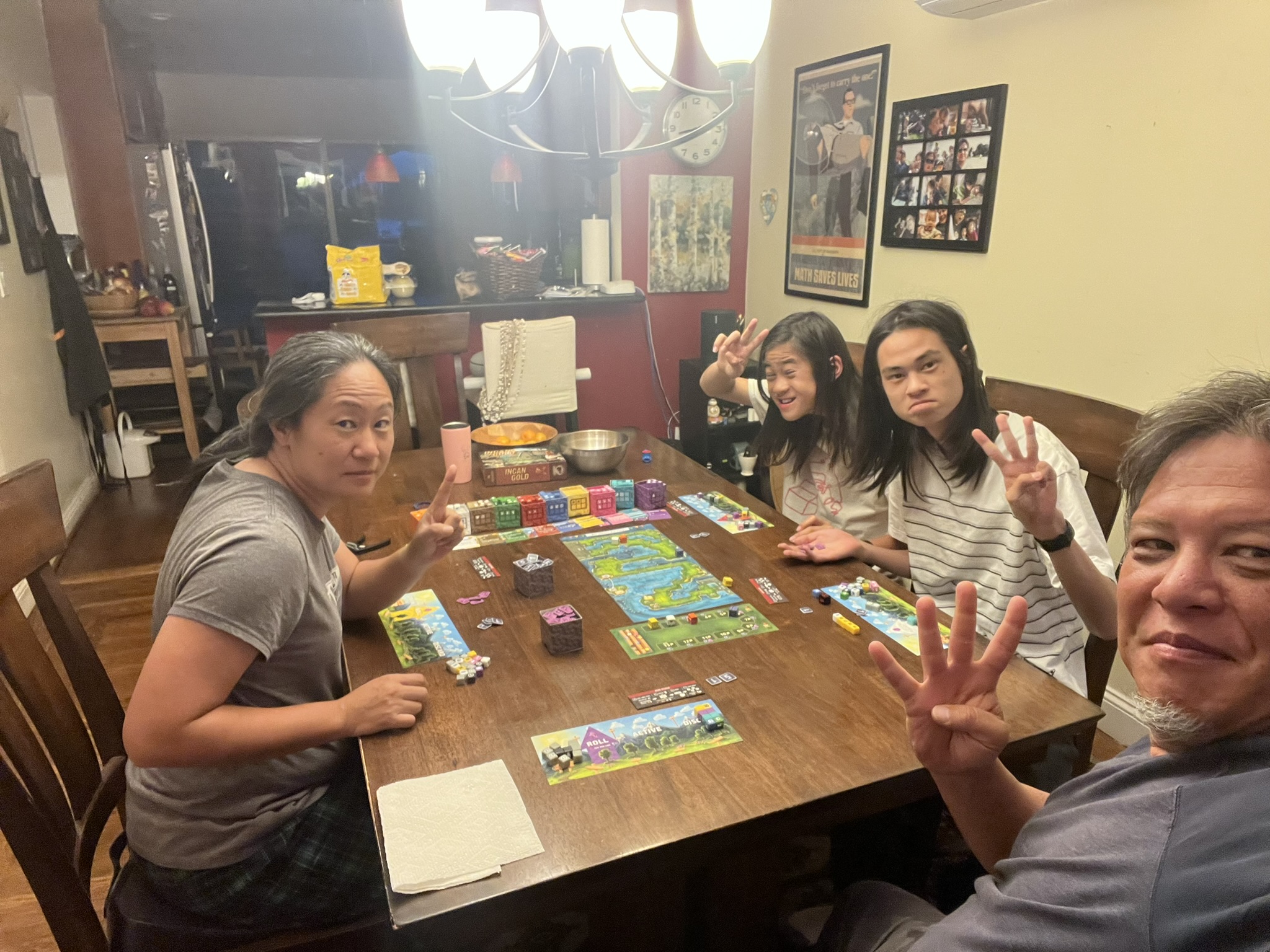
Cubitos is a great little racing game where you buy a bunch of dice, and use them to both buy dice, move, and trigger special powers. A lot like Quacks of Quedlinburg, but with a racing component. You basically try to buy a bunch of dice that generate “combos”, and then hope that you roll well enough to trigger some interesting stuff each turn. At some point, you go from engine-building to buy more stuff to “I’ve gotta get stuff to help me move as fast as possible!”. It’s great. It’s accessible, it’s super fun, there’s some strategy to it, but still a lot of luck. As a family game? Fantastic.

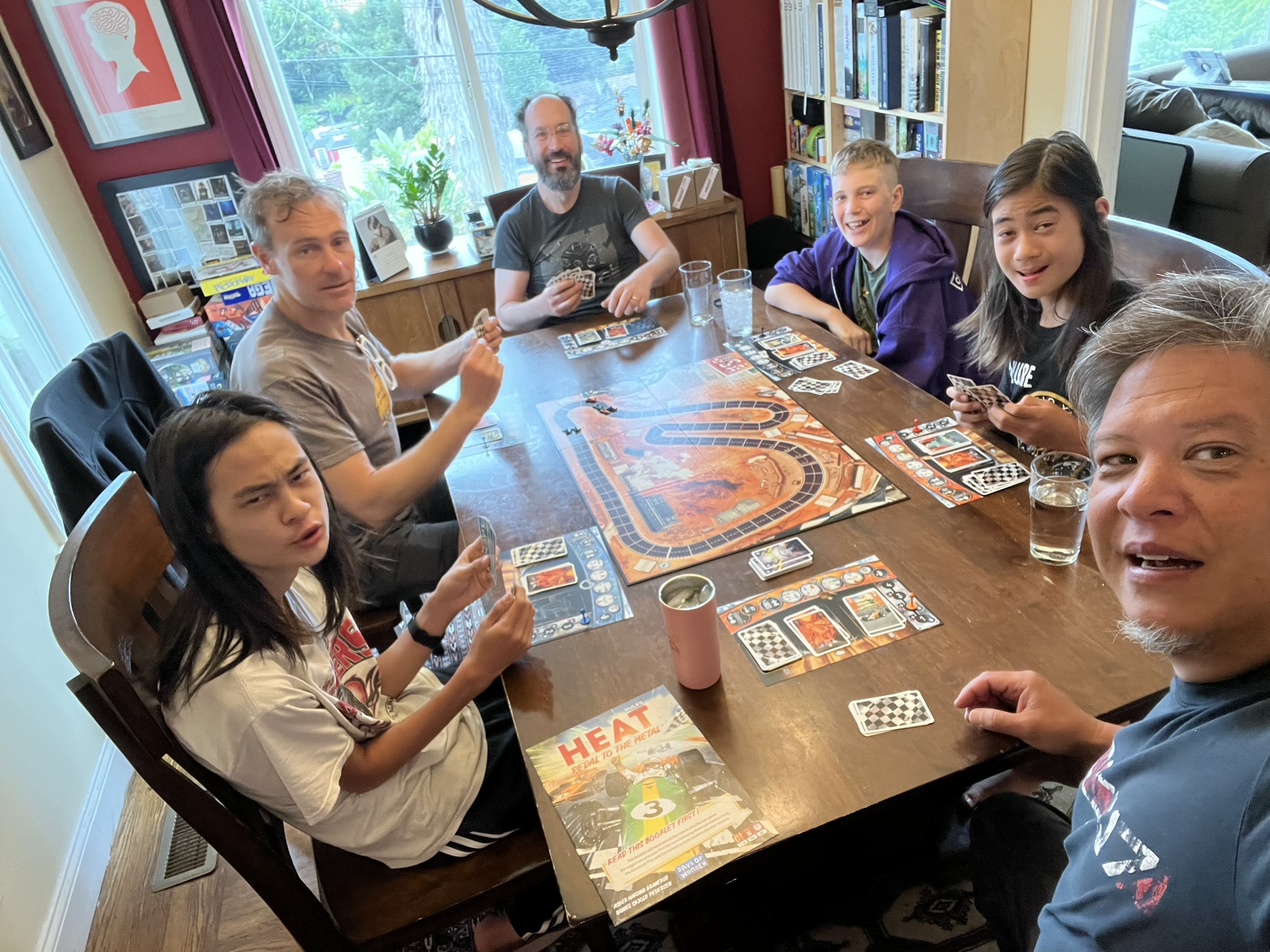
Heat: Pedal to the Metal is one of my new favs. It’s also a push-your-luck racing game, but with a fixed hand of cards. The main decisions in Heat come down to trying to manage your hand to go around corners as fast as possible without overheating your car. You pick a gear to be in, which determines how many cards you can play, and how many cards you want to play is determined by what’s in your hand. And the deck is small enough that you’ll have a pretty solid idea of what’s left in it, but there’s still enough wiggle room for things to go very, very wrong.

Heat is one of the most elegant games I’ve seen in a long while. It’s intense, there’s tons of strategy, and yet the rules are simple, there aren’t many of them, and it all makes thematic sense. It became a huge hit last year, and it’s easy to see why.

A few other games I’ve played recently:

  • Furnace is about as pure an “engine-builder” as you can get. Buy cards to build your factories, and then convert resources into points as efficiently as possible. There’s an interesting bidding mechanic re: how you buy cards, and sometimes instead of buying a card, you’ll want to place second, so that you can use that card’s special ability. It’s an odd game when sometimes the worst thing that can happen is that you can win. Incredibly fast, also very elegant, very enjoyable. I picked this up totally on a lark from someone on Craigslist, and an was very pleasantly surprised.
  • Dorf Romantik – was the other game in that Craigslist purchase. I liked the videogame, it was a nice, zen little tile laying thing. The board game, on the other hand is great. It’s a single-player experience (despite what the box says) with a campaign that evolves the game over time. But it’s still a zen, tile-laying experience. There’s something to the tactility of it, and the low stakes involved. This has become my favorite single-player board game by quite a lot.
  • Dune: Imperium – I managed to get a few friends rounded up multiple times to play Dune, and every time it’s been exciting, close, and tense. We all picked up the app, so weirdly, aside from Gloomhaven, this is the game where we can get together and all not just know how to play, but be quite good at it. And yet, different people & different strategies win every time. It really is dependent on how well you can react to the state of the board and what everyone else is doing. There are times when you just can’t get an engine fired up due to some bad draws or other bad circumstance, but I don’t ever feel like the game is screwing me, it often just feels like I made the wrong decision in the moment. Throw on Hans Zimmer’s soundtrack, and this is thematically on point.

One of the fun things is that sometimes the kids join the adults for games. One of our friends’ sons played Dune with us, and then he, Jin and Kuno all joined for Heat (which supports a lot of players). These games are maybe a little too much for Kuno, still (he really enjoys Cubitos, and wiped the floor with us all in the photo above), but it’s clear that there are a broader selection of available options that’ll be good fits now than there were a year ago, and that space will just get more and more interesting.

Stuff I’ve picked up & am excited to try:

  • Thunder Road: Vendetta – hesitated on this because it seems in practice really similar to the Fast & Furious game by Prospero Hall. But bit anyway, because Mad Max why not.
  • Sol: Last Days of a Star – I’ve wanted this for ages, but it was out of print for years. Jumped on the crowdfunding campaign for the reprint, but haven’t played it yet.
  • Earthborne Rangers – I picked this up in part because it was produced with a focus on sustainability, and the general post-apocalyptic-but-still-optimistic vibe was really interesting. Reviews are over the moon about it, so I’d love to give it a shot. But campaign games are hard to coordinate these days. šŸ™
  • Daybreak – same thing re: sustainability, plus a game about combating climate change from the designer of Pandemic? Yeah, this was a no-brainer for me.
  • Apiary – Stonemaier games almost always get my vote (I passed on Wyrmspan, though – I couldn’t justify it given that we have Wingspan and like it, but don’t play it often enough to justify two similar games). Why? I like Jamie Stegmeyer’s interaction with the audience, his transparency, and what seem to me to be really positive business practices. And always-stunning production values. I mean, Expedition’s mechs were bananas.
  • Let’s Go to Japan! – I got this before we went to Japan, and wanted to get it to evoke memories of that trip. Funny, because it’s a game about planning and optimizing a trip to Japan – something I actually hate doing in practice. I think when it comes to travel, I tend to be more of a “make-it-up-as-we-go” person, but that can often be less ideal than having some measure of a plan before we get there. Fortunately, Ei-Nyung’s a planner and (at least claims to be someone who) enjoys it. So maybe she’ll like this game. šŸ˜€

Ends of Eras

It’s the beginning of summer break, the end of our decade at Crocker Highlands Elementary School, the beginning of Kuno’s time at Edna Brewer Middle School, the end of Jin’s time at Brewer, and the beginning of his at Oakland High School.

Melancholy to be ending our time at Crocker. It’s been a great school for the kids, and a place where I’ve met a bunch of really nice people. We’ve lived in our house for 24 years, but it wasn’t until the kids started at Crocker that I started to just recognize folks from around the neighborhood. It’s weird to think also that families enter and exit this phase of their life every year, and while it’s the end for us, it’s not a transitory moment for most folks.

But both Crocker and Brewer have been great for our family. I think Kuno’s found more of a community earlier, and that COVID disrupted what would have been a pivotal year for Jin, but he’s also found his community among the folks at Brewer, and made good friends over the last year. I’m excited to see what both kids do in the next phase, and am super proud of what they’ve accomplished so far.

Kuno’s blossomed into a crazy artist – constantly making up new characters and doodles and seems to have gotten a lot of acclaim for it from his peers. Jin’s been really mastering animation in Scratch, and recently one of his animations was featured on the front page of scratch.mit.edu. I’m super proud of them both. What a bunch of weirdos.

Return to Dark Tower

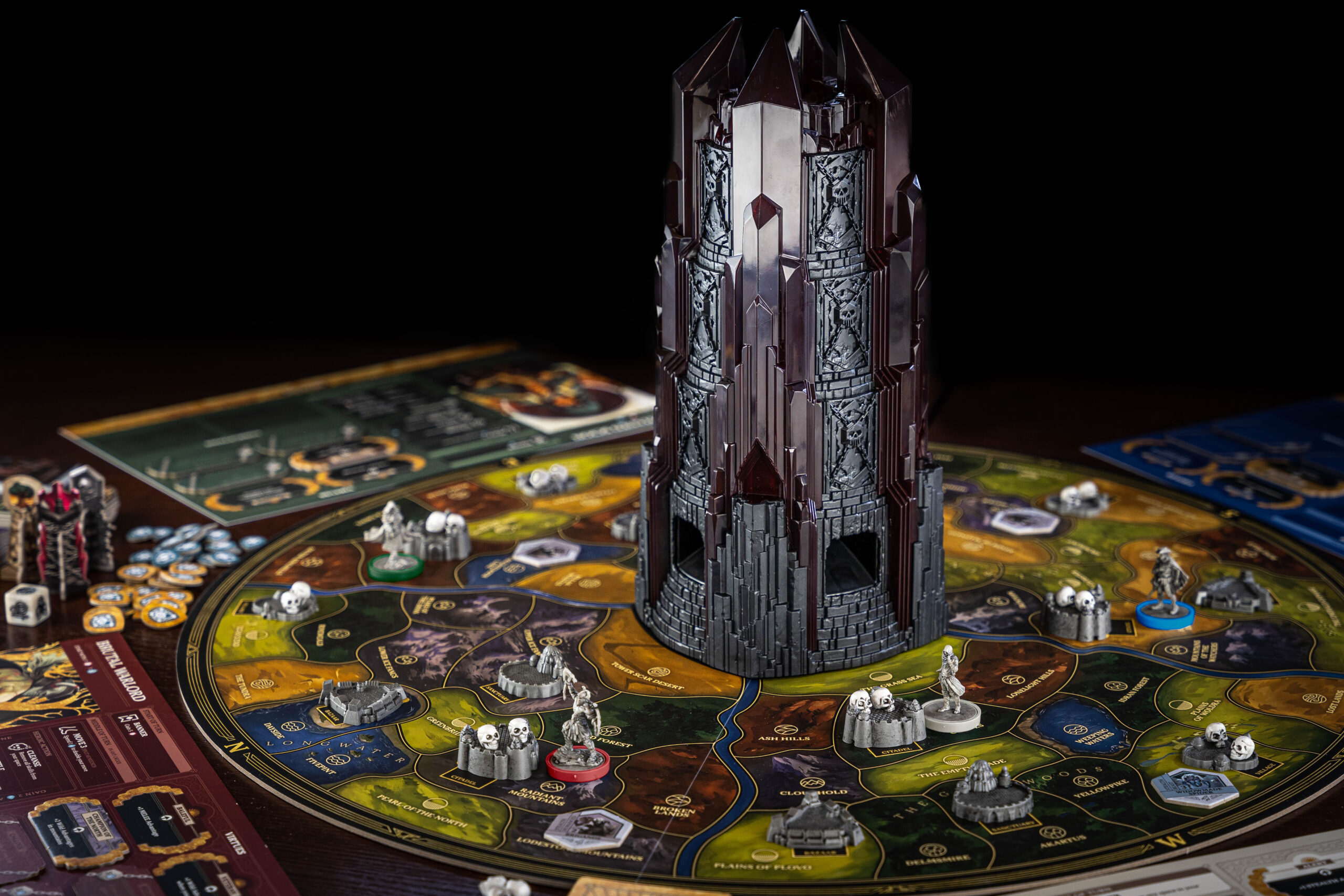
Return to Dark Tower - Restoration GamesI never played the original Dark Tower #boardgame, but I picked up Return to Dark Tower a few years ago, and have managed to play it a few times, now. It’s surprisingly similar to Pandemic, which isn’t what I’d expected.
The game is mostly about managing skulls, which the tower shoots out at you, and the enemies on the board, while trying to accomplish time-limited tasks which cause the board to explode with badness if you fail.

The titular tower & app are a critical part of the experience, but mostly function as ways to make certain things less deterministic. You can’t know when quests will time out. Enemies can vary in power over the course of the game in ways that aren’t totally transparent. Events trigger at the end of turns, and you never quite know what will happen.

All of this *could* be managed with cards & stuff, but it’d make the game tedious and unwieldy. The nice thing is that the app & tower keep the players focused on the board & each other. The one downside is that the tower is so tall that it obscures your view of the opposite side of the map, and the player seated directly across from you – enough so that it feels somewhat difficult to coordinate with the other player.

But at the same time, since the side of the tower facing you spits out skulls, has glyphs that affect the cost of your actions, having it in front of you is essential. And it’s meant to be an imposing presence.

I think when I originally backed it, I thought the tower would do more stuff. In the end, it’s got three sections that rotate, some stuff that lights up, and some “seals” you can slide off, as well as lights and a speaker. It’s nice, butĀ essential? I dunno.

It is, however, a great production. The art is great, the board is clear and readable, the minis and little buildings and stuff are great, and the game strikes a nice balance between depth and accessibility. I’m looking forward to trying out some of the expansions, since they change up how characters work a bit more and are a little bit more intense with powers and penalties and stuff in ways that seem like they’ll be more interesting.

Overall? It’s probably a 7 for me. 5’s a game that I’ll play if someone asks, but won’t volunteer on my own. 3 is something that’s pretty busted. 1 is offensively awful and I’d throw in the trash rather than sell or even donate. 10 is Eclipse or Gloomhaven or So Clover – games that do what they do perfectly. They don’t all have to be big or ambitious. Hell, Glory to Rome is a 10, and it’s a game that is basically about being totally broken. šŸ˜€

So RtDT being a 7 means, “It’s really good, but the base game misses my top-tier games.”

Some random games thatĀ do make the top tier:

  • Beyond the Sun (9)
  • Quacks of Quedlinburg (10)
  • Cubitos (9)
  • Scythe (9)

Image credit: Restoration Games

F1 2025 Driver Lineup Predictions

  • Red Bull: Max Verstappen, Sergio Perez
  • McLaren: Lando Norris, Oscar Piastri
  • Ferrari: Lewis Hamilton, Charles Leclerc
  • Mercedes: George Russell, Kimi Antonelli
  • Williams: Alex Albon, Pierre Gasly
  • Haas: Ollie Bearman, Valtteri Bottas
  • Aston Martin: Fernando Alonso, Yuki Tsunoda
  • RB: Daniel Ricciardo, Ayumu Iwasa
  • Sauber: Nico Hulkenberg, Carlos Sainz
  • Alpine: Esteban Ocon, Victor Martins

Other predictions: Alpine’s latest reorg is another no-op/disaster, and they sell the Enstone team to Andretti, and shut down the Viry engine factory, so that Andretti joins in 2026. This move is announced midway through the 24 season. Stroll is replaced at AM at Honda’s request by Tsunoda. Bottas is brought to Haas after being let go from Sauber as the ā€œexperienceā€, since Haas knows very well that 2 rookies = no bueno.

RB keeps its lineup in 2025, since Perez is doing a great wingman job, and that’s all he needs to do. The foundation of the RB19 is still so far ahead that it coasts to another win, though the pack does bunch up behind them. McLaren challenges, gets some wins. Merc slides, because they’ve decided their focus is 2026. Lewis is competitive in the Ferrari, scoring podiums, but no wins.

Williams starts to move up the grid with the shock announcement that they’ve signed Newey as a consultant – he’s on ā€œgardening leaveā€ and won’t be the technical lead – he doesn’t want to work full-time, but as an advisor to the team, he provides some high-level direction that whips their chassis/aero into shape. Albion’s regularly in the mix for Q3 and significant points in 2025, and by 2026, periodically biting at the podium. Haas under Komatsu continues a bit of a resurgence.

AM/Honda’s first year is terrible – the engine is once again unreliable and slow, and jokes are constant about Alonso + GP2 engines. RB is nowhere, and Ricciardo retires after 2025. Sauber in 2025 is at the back of the grid – Audi’s focused entirely on 26, and while investment in infrastructure is coming in, the 25 car is basically Sauber’s 24 car with minimal changes, and they finish the season second-to-last, ahead of only Alpine.

So yeah – pulling that entirely out of my butt in April 24. Let’s see how wrong I am!

F1 2021

At the end of the 2021 F1 season I swore I’d never watch another race again. I didn’t stick to that, but we watched S4 of Drive to Survive, and I think it really didn’t do a good enough job capturing how astonishingly unjust the end to the season was, and how badly it destroyed the integrity of F1 as a sport. The fact that they never corrected the outcome means that we still talk about Verstappen as a (currently) 3-time World Champion, and Hamilton as a 7-time champion, and that’s simply not how it should be.

And I don’t mean that as a ā€œHrmph, my guy should have won!ā€ I mean that as ā€œThe rules were plain as day, they weren’t followed, and the supposed resolution to the issue was so opaque that there’s never been any explanation or genuine resolution that repairs the integrity of F1Ā as a sport.ā€ At all.

The only possible similar season in my lifetime was the first Senna-Prost collision, and Senna’s disqualification on a technicality. But in 2021, the total failure of F1’s race director and the entire response that followed… there’s been nothing like it.

And the lesson really remains that you can do everything right and still lose, and there is no ā€œkarmic balanceā€, there is no ā€œjusticeā€. The people who cheat, who pressure the ref, who push the boundaries well past the pale will often win, andĀ there’s nothing you can do about it.

The only thing you can do is play the way you believe the game should be played. And if integrity is something you value, then you have to live up to that integrity and bear the consequences. And the consequences are that in the real world, people without integrityĀ win a lot of shit they shouldn’t.Ā And that you can complain about it, and nothing will change. You can be right, and nothing will change. All you can do is accept it, and continue to live up to your own ideals.

Because sometimes your ideals are worth more than a championship. Or they’re worth more than money. Or they’re worth more than pain.

It sucks, but that’s life.

Board Gaming

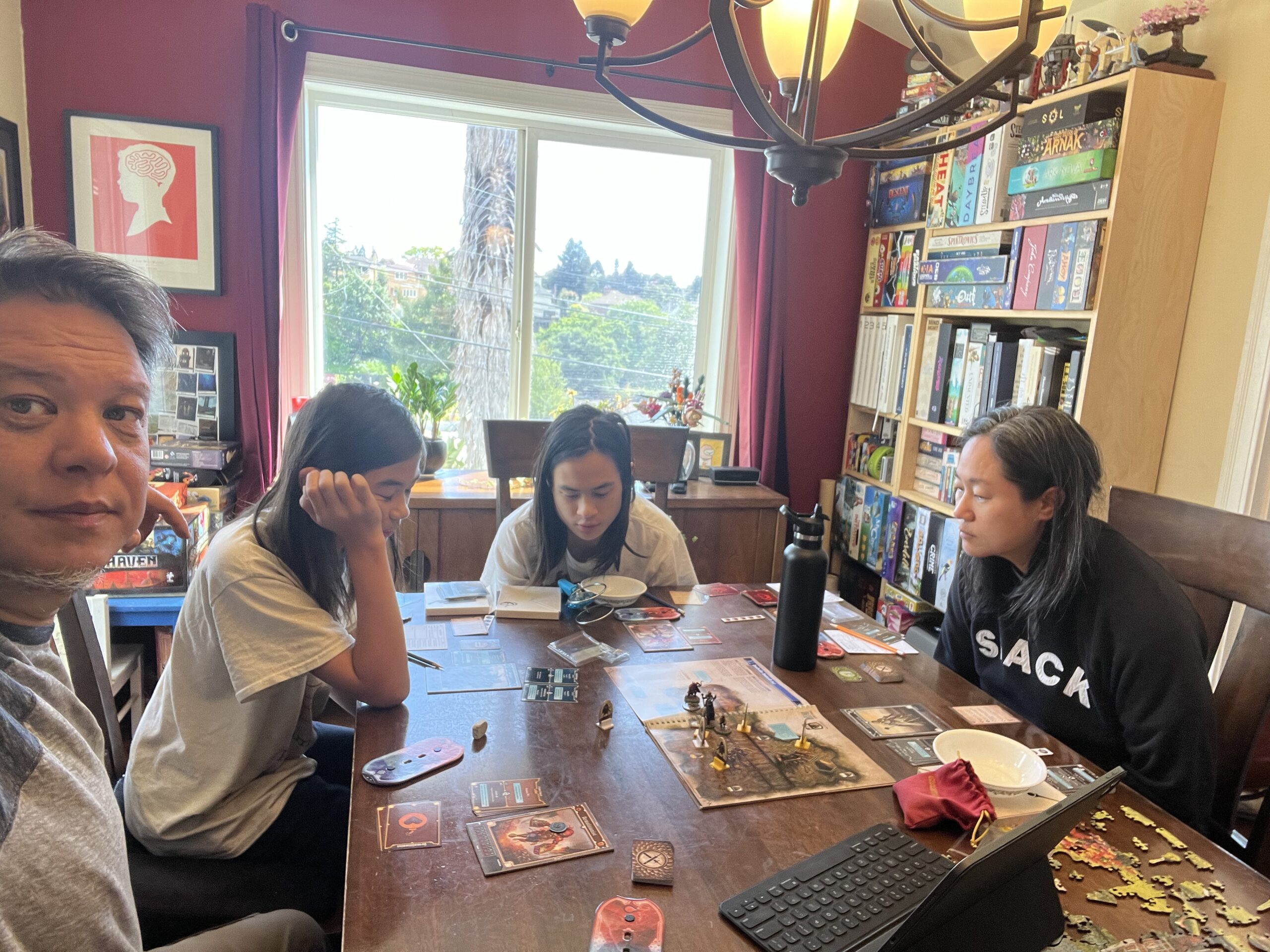
One thing I haven’t written much about here is what board games we’ve been playing. But I’ve been recording every game I’ve played so far in 2024, which has been insightful. We started Gloomhaven: Jaws of the Lion with the kids, which was neat. We’ve played mainline Gloomhaven with our friend Max – probably our most-played board game of the last few years because we’ve had regular get-togethers to just crank through the campaign. I think we’re probably like 80% through the main campaign at this point?

It’s a great dungeon-crawler, and the card-based combat system is incredibly elegant. As a physical game, it’s too big, too complicated, and too unwieldy for me, but with the iPad app Gloomhaven Helper, it’s pretty great. Also works with JOTL, and JOTL is streamlined enough that it makes the whole experience pretty darned fast

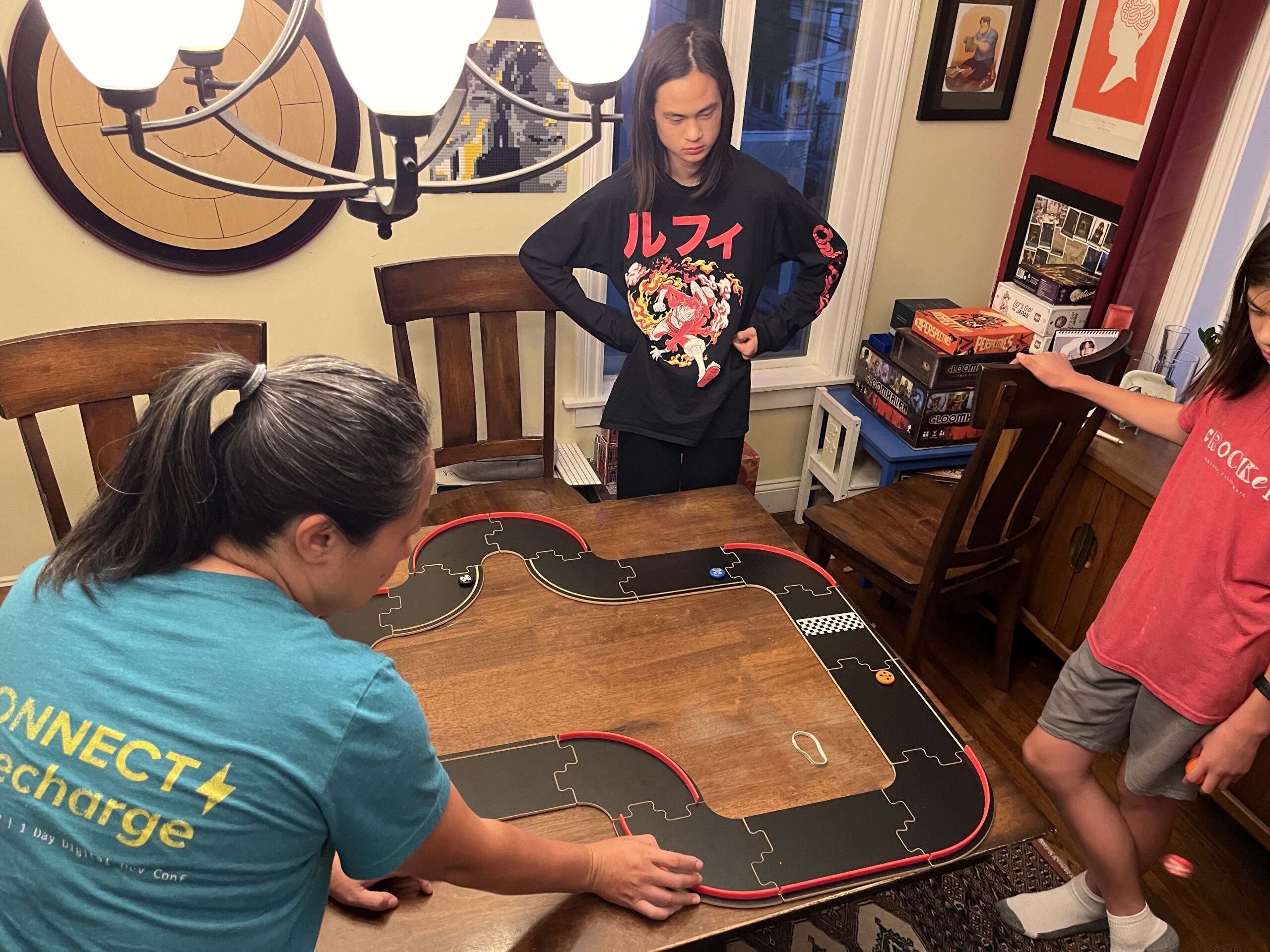
We also played some Pitchcar, which is like Crokinole + Racing, and it’s probably the biggest hit with K, who so far says he likes ā€œsimplerā€ games more. It’s super fun, but the problem is that the kinds of tracks you can make from the included pieces in the base game are limited, but the expansions are impossible to get in the US. I’m gonna try laser-cutting some parts, but because the pieces are MDF + some sort of laminate, getting the thickness and texture right will be impossible. So I think I’m just gonna cut custom track parts, and use those instead of the included track parts – just replace the whole shebang. The big question is if the laser will cut deep enough grooves that the barriers will work. In any case, fun game – super accessible, fast, and building the tracks is as much fun as playing.

Last, I played Return to Dark Tower with Klay & Holly tonight, and that was a good time. I made a really bad decision one turn, and ended up dead due to an event that gave me a third corruption, but we fudged the turn (and a ā€œmake-up conditionā€) in order to keep things moving anyway, and got to the end of the scenario. If I’d not fought the random enemy on my turn, we would have achieved that result anyway. It was a good time. I’m curious to try out some of the expansion content, as the base game is fun, but in many ways feels a bit too much like Pandemic. It’s not that much like Pandemic, it just feels like the same kinds of pressures.

Other recent hits:

  • Project: Elite – played with J earlier in the day. Turn-based alien invasion w/ real-time dice combat. It’s an odd duck, but the real time element actually works pretty well – it’s very simple, but frantic.
  • Dorf Romantik – better than the video game it’s based on, which I like a lot. I’ve only played this solo, but I think that’s the best way to play it. A lovely little campaign, and a very charming, meditative, low-stakes game.
  • Spirit Island – played with Max for the first time. It’s a nice cooperative puzzle that’s complicated enough that it’s legitimately cooperative in a way that relies on everyone to know what they can do and work together.

Yeah – played a LOT of board games over the last few years. Will probably write more about some favorites soonish.

Music Stuff

Still noodling around with making noise. The most recent addition is an Elektron Syntakt. It’s weird – I have a bunch of fairly redundant stuff. The Deluge, Syntakt, JD-Xi, M8 Tracker, OP-Z and Push+Ableton are all broadly similar, functionality-wise. But they’re also all different. The Syntakt and Microfreak and OP-1 all overlap re: sound creation. It’s not like I have a set of “these are things that all do the one thing, and nothing overlaps” – and I think that’s fine.

For a long time I thought I had to optimize and justify all this stuff, but really, the justification is, “I like it, and it’s fun.” Different toys for different moments – sometimes the Roli Seaboard Blocks scratch an itch nothing else does. Or pulling out one of the POs or OPs and just messing around. The M8 is the greatest travel music scratchpad. The Push + Ableton can do basically *everything*, which no other single thing I have can quite replicate (though the Deluge is the closest).

Favorite gear? Sequencing-wise, no question it’s the Deluge. Sound-wise, the Syntakt packs a punch nothing else does, though the Microfreak comes close. The JD-Xi has some VERY punchy drums, and TBH, probably makes the TR-8 obsolete in my setup. And the TB-3.Ā  But whatever. It’s fun. I enjoy it. It’s not “efficient”, it’s not “optimal” and it doesn’t “make sense”.

Fuck it! Who cares?!

Game Design Is An Actual Hard Job With Skills

There are very few people within the game industry that would argue that a good game designer isn’t worth their weight in gold. Why is it that so many folks outside the industry think it’s a trivial job they can do with no experience?

I think if you ask folks, they wouldn’t say that they think game design is a trivial job you can do with no experience. But it doesn’t matter what someone *says*, it matters what they *do*. So when you see someone *say* that game design is a job that requires deep understanding and experience, but then what they *do* is they start up a company and then design the game, despite having no experience doing it, what they’re *showing* is that they think eating pizza is the same as making pizza.

I see this *all over the place*. Educational companies trying to gamify their products. Game-centric startups. Healthcare “games”.

Game design can seem trivial when you think of it as just the high concept. “Let’s make a sci-fi game about rocketships and cat astronauts who land on a planet made of yarn!” But the high concept has to *do* something. It has to be the foundation of a whole wealth of interactions and decisions. Why cat astronauts? Why space? Why yarn?

Building games is about *focus*. Good ideas are all around you, and if your only metric is “this idea is good!” you’ll end up heading in 20 different directions. Most games? They’re about ONE core idea. Sure, that idea mutates everything it touches, so the whole game seems new. But every single feature – every single system you introduce into the game blows its complexity exponentially.

So a great game designer’s job is keeping the possibility space as interesting and as *simple* as possible. That complexity has to be *focused*. Every game I’ve designed that has failed has failed not because it was too simple, but because it was too complicated. Every game I’ve designed that has succeeded did so *because* it was simple, and could grow into something more complex.

Simplicity is *extremely difficult*. It’s very easy to grow, and very hard to pare down. My record of it is probably 50-50 at *best*, and that’s with *decades* of experience and insight and iteration. It’s an incredibly challenging, multidisciplinary problem that requires insight into a lot of different fields – art, psychology, technology at minimum – to really understand.

And yet, so many teams, and so many companies think it’s something they can do with zero experience, because they’ve played games.

I get it. And frankly, every experienced designer started that way. But most started on smaller projects, or by working for more experienced folks they could learn from. Starting up a company is a *terrible* place to learn game design, and if you think you’re the exception… you’re probably wrong.

Writing a Thing

Last year, when Eric Nehrlich was writing his (excellent) book You Have a Choice, we buddied up to be ā€œaccountability partnersā€. I started out wanting to write about my perspective on product development and team leadership, but I beat my head against it for a month before giving up. There was too much, it was too interconnected, and I couldn’t figure out how to make it all sensible. I ended up writing my little resume booklet.

I thought this year, I’d revise that booklet into something better – but I bounced off of that, too, because while it’s not perfect, it actually says everything I need it to say. I’m sure parts of it could be clearer, it could use a real example resume that goes from being bad to good, etc. But all the knowledge I wanted to get into it? It’s in there already. So I keep rewriting little bits of it, but I go back and re-read them, and they’re maybe marginally punchier, but there’s no new knowledge in there. So it got to feeling like I was running on a treadmill for no reason.

Tonight, my subconscious finally solved the first problem, after a year of working on it. I always feel like these answers emerge like a submarine breaking through the water’s surface or something. But it hit me:

For how to communicate ideas to a team well, read Simon Sinek’s Start With Why. Or better yet, just watch his YouTube video about The Golden Circle. It’s everything great in the book without the fluff.

For how to incentivize and structure a team & peoples’ responsibility, and how to think about motivation, read Daniel Pink’s Drive. There’s an RSA Animate thing about that book, but I found it worth actually reading the whole thing.

For how to lead a team in a really interesting way, and to harness everyone’s complete potential, read L. David Marquet’s Turn This Ship Around. The entire book is essential reading for anyone in a position of power, and it will totally discombobulate your concept of what a leader’s real role is.

Those books are not exactly my worldview, but much like the current version of my resume book, they’re also ā€œclose enoughā€, and the things I’d have to add to that are mostly practical examples of how to put this stuff into practice in reality.

So now that I’ve completely buried the lede, the point is this:

Those books exist. They describe most of my perspective on team leadership and product development. But there is something that I’ve found that isn’t in those books, that was spawned by my specific experience, and is deeply fundamental to how I now think about product development and communication. And I think if you’ve followed my posts on LinkedIn for a bit, this next section will be really obvious.

The book I’m gonna start working on now I think will be called Anima. The subtitle will be something like ā€œHow to solve every single problem with your product in one sentence.ā€

Maybe that’s too hoity-toity. I dunno. But that was the submarine that emerged from the deep. I can offload all the team leadership & most of the communication stuff onto those other books. They’re ā€œgood enoughā€, and unless I can contribute something substantial and worthwhile, you should just read those. The thing that I can contribute is this.

One sentence.

It’s a way to think deeply about every single bit of your product. It’s your North Star. It’s the sword you use to hack away the unnecessary parts. It’s how you empower everyone on your team.

And yeah, I know – grandiose claims. Sounds delusional. But the number of times over the years that it’s helped – and the number of times I’ve resisted doing it and failed, only to realize that not doing this process is *why* it failed – I think this is something that is uncommon in product development. And it’s uncommon in team leadership. And most important of all, I think when people think about giving a team responsibility and autonomy, this is the missing link – you can’t give people responsibility and autonomy without *understanding*, and *so frequently* when I talk to folks who are having team leadership/communication/product problems, it all comes back to this issue. That most people, most of the time, hand wave away a lot of uncertainty and lack of clarity, but that uncertainty/lack of clarity causes communication problems, prevents people from acting with autonomy, creates bottlenecks, etc. etc. etc.

So yeah. The one thing I want to communicate, it turns out, is the concept of ā€œone thingā€, and how you can totally supercharge everything you do in a startup or product development process by figuring out how to communicate what you’re doing to your customers and your team in one sentence.

Why I Can’t Be a Fractional Product Person

Over the years, the idea of a part time product-person role has come up. A fractional CPO, or something of that ilk. I have friends (and family) doing fractional CTO work, and that’s always seemed sensible to me. I *want* a fractional CPO position to work, because that’s the kind of work I’d love to be looking for.

But I’d never, ever hire a fractional CPO, and I’d recommend that you don’t, either.

I get why you’d want someone in that role. There’s some sort of limited-domain or limited-size product knowledge that you don’t have, and an injection of experience could make a huge difference. Your company is otherwise good, and the person leading the product charge currently can do *most* of the job, they just can’t quite do all of it.

But here’s the problem: The product is the business.

Yeah, you can make similar arguments that the tech stack/process is the business, or marketing is the business, or whatever. But I’m a product guy, so for me, the product is the thing. And it’s not just my bias. I think that your product is so central that the decisions you make around product will bleed out into everything else, and everything else about your company will similarly bleed into your product.

The problem with a fractional CPO is simple: They will never endure the full pain of their decisions.

Product pain comes in many forms. A consultant can be very good at solving short-term pain. But the problem is that many solutions to short-term pain cause long-term pain. And if your consultant isn’t around for the long term, they don’t consider that pain to the degree that they should.

That’s it. That’s the whole problem. But it’s unsolvable. Because no amount of intellectualizing or rationalizing how you’re anticipating that long term pain is the same as knowing that it will one day punch you in the face at the worst possible moment. Even full-time folks often make this mistake. But fractional product people are heavily incentivized *to make this exact mistake*, and because of that, they will – consciously or otherwise.

This is the central bit of your business, and an absolutely critical thing to get right. If you are having product problems, you need *full time*, heavily invested people who can fix those problems. If you can’t afford to hire a full-spectrum product person with the expertise you need, you are failing to hire one of the single most critical roles for your business, and your chances of failure will skyrocket.

I know it seems like a fractional CPO can be that boost of product knowledge you need. It means you don’t have to expand at a time when expansion is scary and expensive. But it is a bad investment. It will always be a bad investment, and the problem is that it will seem good until it catastrophically fails. Please don’t do it. You need a full-time product-focused person with the necessary expertise as a central role in your company.